Compare
Best GLP-1 Tracker Apps: Zuyu, Shotsy, MeAgain, Pep, Glapp and Glippy Compared
Updated 22 September 2026.
If you are taking a GLP-1 medication, you are generating a surprising amount of information: which day you dosed, which site you used, how the first two days felt compared with the last two, what your weight did, what you meant to ask at your next appointment. Almost nobody remembers that accurately three weeks later, which is why this category of app exists at all.
The apps below all help with that, and they are not interchangeable. They disagree about something more basic than features: where your record lives, and who has to know your name for it to work. That is the difference worth deciding on first, because it is the one you cannot change later without starting your history again.
Everything here was checked against live App Store and Google Play listings, the developers' own websites and their published privacy policies, most recently re-checked on 22 September 2026. Store figures move, prices in particular are unusually unstable in this category, so treat the numbers as a snapshot and check the listing before you subscribe.
The short version
| Zuyu | Shotsy | MeAgain | Pep | Glapp | Glippy | |
|---|---|---|---|---|---|---|
| Account needed | No, on both platforms | No on iPhone; Google sign-in on Android | Not stated | Optional, only for cloud backup | Built around an account for sync | No, for local use |
| Where entries live | On the device, encrypted; not transmitted | iPhone: your own iCloud. Android: the developer's Firebase | Not stated | On the device by default; optional cloud backup (Supabase/AWS, US) | Cloud sync | On the device; optional cloud backup, not end-to-end encrypted |
| Tracking declared to Apple | None declared | Not checked | Yes, identifiers and usage data | Yes, identifiers | None declared | None declared |
| Platforms | iPhone, Android | iPhone, Android, Mac | iPhone, Android | iPhone, iPad, Android | iPhone, Android, Apple Watch | iPhone, iPad, Mac, no Android |
| Free tier | Yes | Yes | Yes | Yes, Pep states it covers its medication-level chart and Apple Health sync | Yes | Yes |
| Published price | $9.99/mo, $59.99/yr | Several concurrent prices, $9.99–$59.99 | Several concurrent prices, no periods shown | Several concurrent prices, $9.99–$39.99 | $4.99/wk, $9.99/mo, $39.99/yr | Core tracking free; cloud backup $1.99/mo, $19.99/yr |
| Injection-site map and dosing-rhythm chart | Yes, both, shown in the app | Site history plus a paid medication-level chart | Site history plus a medication-level estimator | Site history plus a free medication-level chart | Site history plus a medication-level chart and Watch view | Site history; no medication-level chart |
| Body measurements | Weight only | Weight | Weight, plus progress photos | Weight, body measurements, progress photos | Weight | Weight |
| Food logging | Not offered | Calories, protein, water | Yes, extensive | Yes, extensive | Positions itself alongside one | Not stated |
| Clinician report / PDF export | Yes (Plus) | Yes | No | Not verified | Not verified | Not verified |
Blank-looking cells matter. "Not stated" means the developer has not published an answer either way, and we have not assumed one. That standard is applied to our own app too.
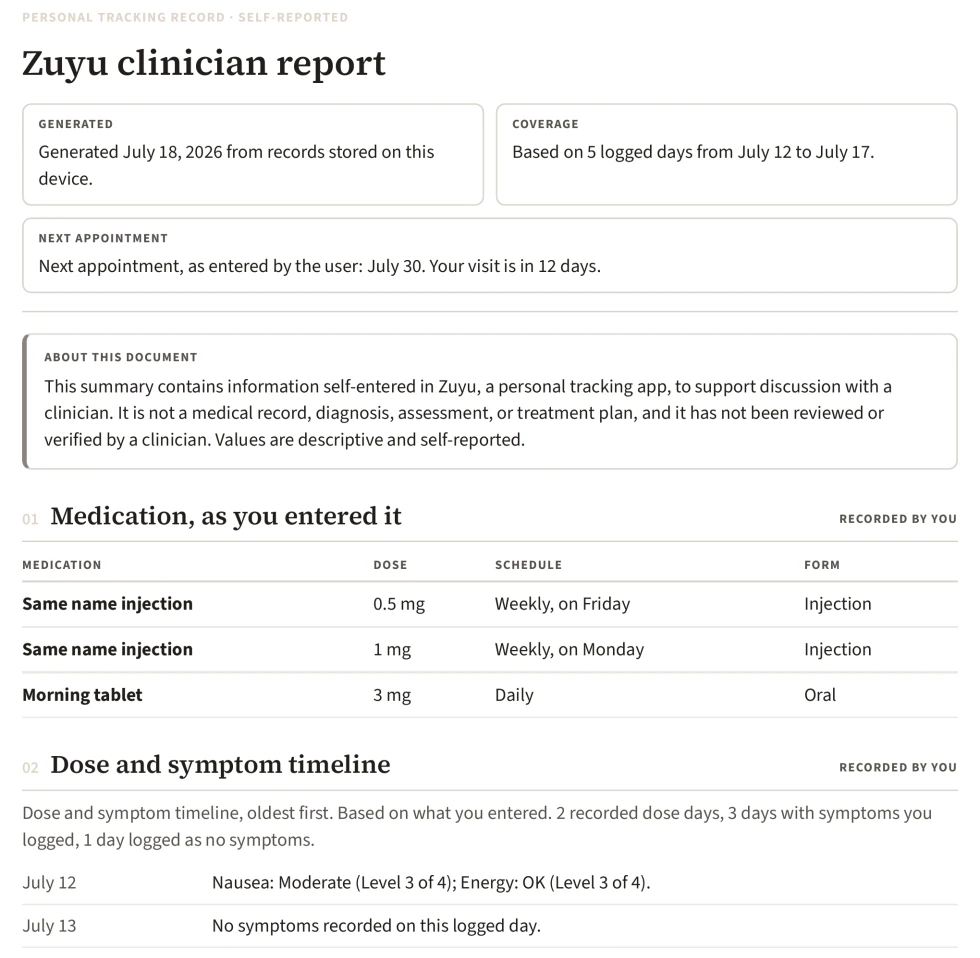
Every app in this comparison lets you log the day. Fewer of them turn that log into something a clinician can actually read in a seven-minute visit. Zuyu's Plus tier assembles what you have recorded, doses, sites, symptoms, weight and notes, into a clinician-ready report you can view in the app, print, and share as a PDF, exactly as it ships today. It is an organizational summary of what you entered, not a medical read of it: it does not diagnose, interpret results, score medical risk, or recommend treatment. Shotsy also produces a PDF summary. MeAgain's own comparison page states it does not offer PDF export. Pep and Glapp may or may not, we could not verify either way from their published materials, so the table says "Not verified" rather than guessing.
The question to answer first: does it need an account?
Most comparisons in this category start with feature counts. We think that is the wrong end. A GLP-1 record is a list of the medications you take, on what schedule, and what they do to your body. Whether that list requires an identity attached to it is a structural decision the developer made before you ever opened the app.
Three apps here are genuinely account-optional. Zuyu requires no account on either platform, there is no sign-in screen to skip, and the privacy policy states health entries are not sent to a server and are not synced through iCloud Drive, CloudKit or any other cloud service. Pep stores locally by default and asks for an account only if you want cloud backup, which it charges for. Glippy works fully without an account and reserves sign-in for optional backup and AI insights.
Shotsy is the interesting case, and it is the thing most readers get wrong. On iPhone it needs no account and keeps your entries in your own private iCloud database. On Android, its own privacy policy states it requires Google Sign-In and stores your data in Google Firebase, a backend the company controls. Same app, materially different arrangement, depending on the phone in your pocket. Shotsy publishes this plainly; it is simply not the part anyone quotes.
Glapp is built the other way round on purpose: an account and cloud sync are the point, because it wants your record on your phone, your Mac and your Watch at once. MeAgain does not state its requirement either way in any source we could find, so we are not going to guess at it.
What each app is actually for
Zuyu, the appointment, and nothing leaving the phone
Zuyu is built around a short daily check-in and the visit at the end of it. You log the day by typing or by voice, record medications, doses, injection sites and supply, note weight and how you felt in your own words, and the app assembles that into a report you can take to your clinician. It also builds a front-and-back body map of your injection-site history and an estimated medication-presence chart from the doses you have recorded, both shown in the app itself. The free tier covers the logging, injection sites, supply recording, raw export of everything you have entered, and backup and restore. The paid tier, Plus, is the finished clinician report with PDF, print and share, the report archive, ongoing voice check-ins after a seven-day trial, custom reminder times, a shot-day checklist and a supply projection.
Two things genuinely separate it. Voice check-ins use the device's own speech recognition, and the app states it will not fall back to a network recognizer, if your phone cannot do it on-device, Zuyu tells you rather than sending your voice anywhere. And raw export is free on every plan, which means leaving is always possible.
What Zuyu is not: it does not log food, it has no community, it has no AI feature, and at 33.7 MB on iPhone it is the smallest app here by a wide margin, because it does less. It also tracks weight but not other body measurements such as waist circumference. It is also brand new, while Shotsy and MeAgain are each among the most established apps in this category, with a large, long-running user base behind them. If a road-tested track record is what reassures you, that is a real argument against us today.
Shotsy, the analytics-heavy category leader
Shotsy is the most established app in this comparison and the most feature-complete for someone who wants to see patterns. It covers the full injectable line-up plus oral forms on iPhone, tracks injection-site rotation, side effects with severity, and weight, and charts progress by dose level and by site. Its signature paid feature is an estimated medication-level curve built from published clinical data. It ships in 17 languages, runs on Mac, and produces a PDF summary designed for you to bring to an appointment.
If you want the deepest analysis of your own data and the largest body of users behind the app, this is the strongest candidate here, and it is fair to say so. The trade-offs are that it requires iOS 18, its Android build needs a Google account, and its subscription price is not published anywhere on its own site.
MeAgain, the everything-in-one-timeline daily companion
MeAgain has the broadest feature surface of any app here. Shots and oral doses, injection sites, side effects with a severity scale, weight, progress photos, and food logged by photo, barcode, voice or search, with protein, fiber and water as the targets rather than calories. It has home-screen widgets, an AI companion character, community features and a medication-level estimator. It is, alongside Shotsy, one of the most established and widely used apps in this comparison.
If you want one app to hold your whole day and you enjoy a product with personality, MeAgain is the most complete answer. Two things to weigh against that. Its own App Store privacy label declares that identifiers and usage data may be used to track you across other companies' apps and websites, and that health and sensitive information are linked to your identity, with advertising and marketing among the stated purposes. Separately, MeAgain's own comparison page states it does not offer PDF export, so if walking into an appointment with a printed summary matters to you, check that before you commit.
Pep, the free tier Pep says covers the most
Pep is the app most likely to make you question whether you need to pay anyone. It covers injections and oral pills, site rotation, side effects, weight, body measurements and progress photos, a searchable food database with barcode scanning, customizable reminders, and an estimated medication-level chart, and its own comparison pages state that the medication-level chart and Apple Health sync are in the free tier, which some rivals charge for. AI photo food scanning is the main paid feature. It runs on iPhone, iPad and Android, in ten languages.
Its privacy policy is also the most specific of any competitor here: it names its host and region, describes encryption at rest and in transit, and says progress photos are encrypted on the device before upload with a key tied to your password. Set against that, its App Store label declares identifiers used to track across other companies' apps and device identifiers used for the developer's own advertising, and its policy names no advertising or analytics vendor.
Glapp, the best logistics, and the dose cycle
Glapp treats the weekly rhythm of an injectable as the organising idea. It models an estimated medication-level curve, forecasts the phases of a dose cycle, and ties weight, side effects, hunger, sleep and mood back to where you are in that cycle. It benchmarks your progress against clinical-trial data, per its own store listing, and includes a research-search feature.
Its clearest advantage over everything else here, including us, is supply logistics: vials and pens, concentration, volume, beyond-use dates, automatic deduction as you log each dose, and a forecast of when you run out. Zuyu records supply; Glapp manages it. Glapp also has a real Apple Watch app, which nothing else in this comparison offers.
The trade-off is architectural: Glapp is account-based cloud sync. Its App Store label declares no cross-app tracking, but health data is linked to your identity. We could not retrieve its privacy policy or terms at all, both pages load their text in a way our tools could not read, so encryption at rest, retention and server location are simply unknown from the outside.
Glippy, the closest thing to Zuyu's idea, on iPhone only
Glippy is the app nearest to Zuyu in philosophy. Local-first, no account for local use, free core tracking, and free JSON export. It logs shots, doses, injection area and site, weight trends over several windows, and, uniquely here, optional menstrual-cycle context alongside the GLP-1 log. Its paid tier is a small subscription for cloud backup and AI-generated pattern explanations.
It also deserves credit for candour: its privacy policy states outright that cloud backups are not end-to-end encrypted, and it names its processors rather than hiding behind a slogan.
The practical limits are real. There is no Android version, the developer's own FAQ says so. It does not connect to Apple Health. It is a young app. One caution if you go looking for it: there are two different apps called Glippy from two different developers. The one described here is "Glippy: Private GLP-1 Tracker".
Which one may fit you
Zuyu is the only app here that answers that identically on iOS and Android. Pep and Glippy come close: Pep stores locally by default and makes the account optional, Glippy does the same but has no Android app. See Zuyu vs Pep on free features.
This narrows fast. Shotsy requires a Google account and a vendor backend on Android; Glippy has no Android app at all. Zuyu and Pep are the two to look at. See how Zuyu and Shotsy differ on Android.
Shotsy, then Glapp. Both estimate medication levels over time; Shotsy has the larger evidence base and user base, Glapp ties the cycle to how you feel and adds a Watch app. See how Zuyu and Glapp handle supply tracking.
MeAgain or Pep. Zuyu does not log food and is not trying to. See MeAgain compared feature by feature.
Glapp, clearly. This is the dimension where it beats everything else in the comparison.
Zuyu and Shotsy both produce a clinician-facing PDF. MeAgain's own materials state it does not.
Shotsy or MeAgain, both among the most established apps in this category. Zuyu is new.
Glippy is the only app here that offers it.
Common questions
- Do any of these apps work without giving up my email?
- Zuyu requires no account on either platform. Pep and Glippy work without one for local tracking and ask for sign-in only for optional cloud backup. Shotsy needs none on iPhone but does on Android.
- Is any of these HIPAA-protected?
- No. Zuyu states plainly that Nb41 Labs does not claim HIPAA compliance. MeAgain states its data is not protected health information and that it is not a covered entity. Consumer tracking apps are generally outside HIPAA, that framework covers healthcare providers and their business associates, not an app you downloaded yourself.
- Can I get my data out if I change my mind?
- Zuyu includes raw export of everything you have logged on every plan, including the free one, plus backup and restore. Glippy offers a free JSON export. Shotsy's release notes reference CSV export. For the others we could not verify an export function either way from published materials, which is not the same as saying they lack one, it is worth asking before you commit a year of history.
- Why do the prices keep changing?
- Several apps here show multiple concurrent price points for what appears to be the same subscription. Check the price in the store on the day you subscribe.
Health disclaimer. Zuyu is an organizational and appointment-preparation tool. It is not a medical device. It does not diagnose, treat, cure, or prevent any medical condition, it does not prescribe or recommend dose changes, and it does not replace professional judgment or medical advice. Always consult your healthcare provider before making any decision about your treatment. Zuyu is intended for adults 18 and over.
Comparative information on this page was taken from the developers' live App Store and Google Play listings, websites and published privacy policies, most recently re-checked on 22 September 2026. Product details change; check the current listing before purchasing. Product names and trademarks belong to their respective owners.
Try Zuyu
Zuyu is free to start, with no account and no card. Your check-ins stay on your phone in an encrypted database, and raw export is included on every plan.


Essential is free. No account. United States. Adults 18 and over.