Compare
Zuyu vs Shotsy: The Same App Behaves Differently on Android
Updated 23 September 2026.
Shotsy is the most established app in GLP-1 tracking and the most complete for anyone who wants to study their own patterns. Comparing it with Zuyu means weighing a mature, analysis-rich product against a newer, deliberately narrower one.
One fact ought to shape that decision more than any feature list, and it is published in Shotsy's own privacy policy rather than in anyone's marketing: its account requirement and its storage arrangement are not the same on Android as they are on iPhone.
The short answer
On iPhone these two are closer than most people expect: neither needs an account, and neither declares any tracking to Apple. On Android they diverge sharply, because Shotsy requires a Google sign-in and stores your entries in a backend it controls, while Zuyu behaves exactly as it does on iPhone. Against that, Shotsy analyzes your data more deeply, integrates with Apple Health and Health Connect, ships in 17 languages, and has years of use behind it.
How they compare
| Zuyu | Shotsy | |
|---|---|---|
| Account required, iPhone | No | No |
| Account required, Android | No | Yes, Google Sign-In |
| Where entries are stored, iPhone | On the device, encrypted; not transmitted | Your own private iCloud database |
| Where entries are stored, Android | On the device, encrypted; not transmitted | Google Firebase, a developer-controlled backend |
| Cross-device sync | No | Yes, through iCloud or Firebase |
| Cross-app tracking declared | None declared | None declared |
| Health data linked to you | No | No |
| Clinician report and PDF | Yes, in the paid tier | Yes; tier not stated |
| Raw data export | Yes, on every plan | Yes, CSV; tier not stated |
| Injection sites | Yes | Yes, with rotation |
| Medication-level chart | Yes, free | Yes, in the paid tier |
| Side effects | Yes | Yes, with severity |
| Weight | Yes | Yes |
| Other measurements | No | Not stated |
| Food logging | No | Limited: calories, protein and water |
| Voice logging | Yes, recognized on-device | Not stated |
| Apple Health, Health Connect | No | Yes, in the paid tier |
| Platforms | iPhone, Android | iPhone, Mac, Android |
| Minimum iOS | 15.1 | 18.0 |
| App size, iPhone | 33.7 MB | 126.1 MB |
| Languages | English | 17 |
| Subscription price | $9.99 a month, $59.99 a year | Not published by the vendor; store shows $9.99 to $59.99 |
How to read this table. Yes means a first-party source confirms it. No means a first-party source establishes it is absent. Limited means it exists in a narrower form than the row describes. Not stated means the developer publishes no answer either way, and we have not assumed one. The same standard is applied to Zuyu, which is why Zuyu carries a "No" in four rows on this page.
The Android difference
Shotsy's privacy policy sets out two architectures. On iOS it states that no user account is required and that health entries live in a private iCloud database tied to your Apple ID: your iCloud, not the company's servers. That is a genuinely strong arrangement and close in spirit to Zuyu's.
On Android, the same policy states that the app requires Google Sign-In and stores data in Google Firebase. The Play listing itself carries a sign-in prompt. Firebase is infrastructure the developer controls, not storage you own. Shotsy publishes this plainly; it is simply asymmetric.
Zuyu makes the same promise on both platforms. There is no sign-in screen on either, and the privacy policy states that medications, doses, symptoms, notes, weight and supply figures are not transmitted to Nb41 Labs, and that the app does not use iCloud Drive, CloudKit or any other cloud service to store or synchronize entries. The cost of that consistency is real: Zuyu offers no cross-device sync at all. If you want your log on a phone and a Mac at once, Shotsy can do it and Zuyu cannot.
What each app declares to Apple
Both apps come out of this well, and it is worth being precise rather than flattering. Shotsy's App Store privacy label declares no tracking and nothing linked to your identity: every data type it declares, including health and fitness, sits under "Data Not Linked to You". Zuyu's label declares only purchase history, a user ID and diagnostics, also under "Data Not Linked to You". Neither app declares cross-app tracking.
Zuyu is not a closed box either. Its privacy policy names Sentry for crash diagnostics and RevenueCat for subscriptions, and states that those services do not receive your health entries. Shotsy's policy names Firebase Analytics, Mixpanel, AppsFlyer and Google Analytics among its processors, states that it takes steps to avoid sending health entries through those tools, and states that it does not sell personal information.
So the privacy difference between these two is not about advertising or tracking. It is narrower and more structural: what happens on Android, and whether there is any cloud path at all.
Where Shotsy is the better app
Depth of analysis. Shotsy's paid tier estimates how much medication is in your system over time using published clinical data, and charts progress by dose level and by injection site. If understanding your own patterns is the job you are hiring an app for, Shotsy does more of it.
Integrations. Shotsy reads from Apple Health and Health Connect in its paid tier, so weight and related metrics can arrive without retyping. Zuyu offers neither connection.
Reach and maturity. Seventeen languages against Zuyu's English, a Mac app, oral GLP-1 support on iPhone, and a long-running user base behind it. Zuyu was released in September 2026. That gap is exactly what you would expect, and it is still a real difference in how much road-testing stands behind each product.
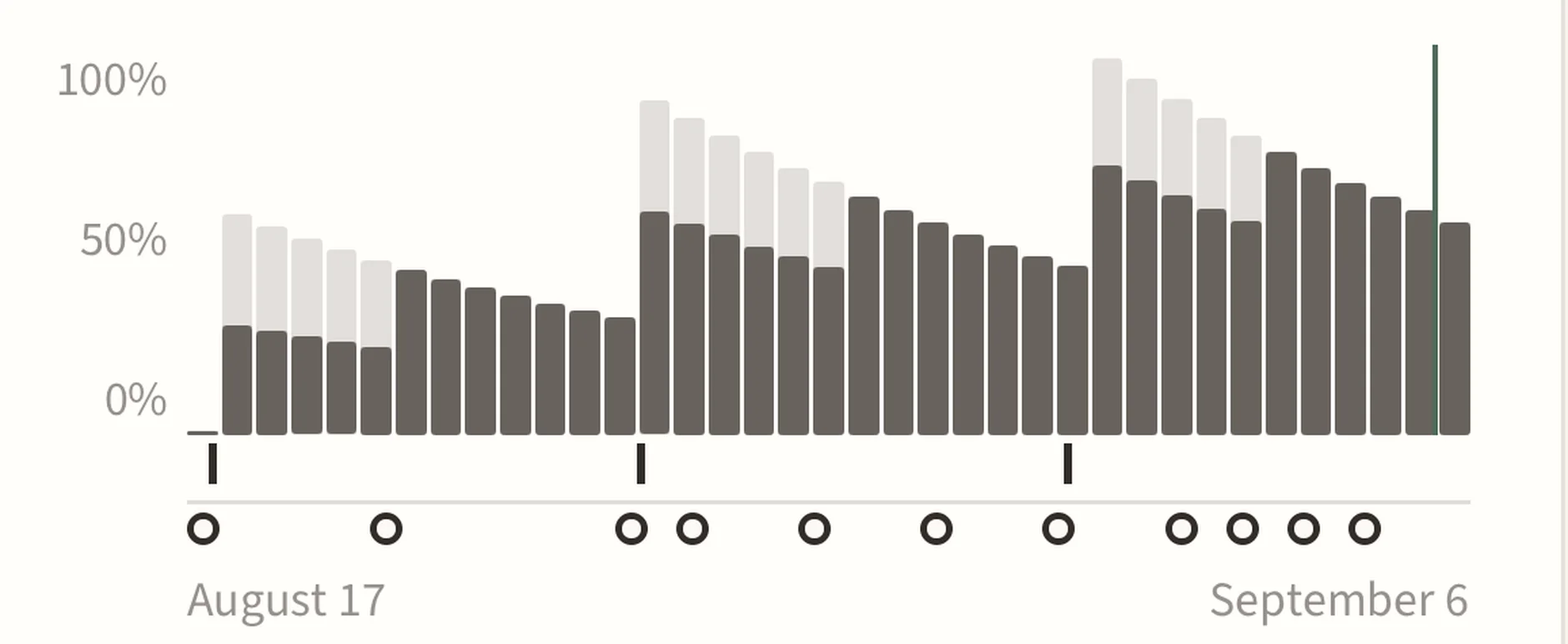
Both apps turn dosing history into a picture of a rhythm rather than a list of dates. Shotsy's version is built from published clinical data and goes further, breaking the curve down by injection site as well as by dose. Zuyu's is simpler, and it is in the free tier rather than the paid one.
Where Zuyu is different
One answer on both platforms. No account, no sign-in, nothing synced, on iPhone and Android alike.
Voice that stays on the phone. Zuyu's voice check-ins use the device's own speech recognition, and the app states it does not fall back to a network recognizer. If the device cannot recognize speech on-device, Zuyu says so rather than sending audio elsewhere. No audio file is saved, and no transcript leaves the phone.
Export is free, permanently. Raw export of everything you logged sits in the free tier, with backup and restore. Leaving is not a paid feature.
It runs on older iPhones and takes less room. iOS 15.1 against Shotsy's iOS 18.0, and 33.7 MB against 126.1 MB. On an older device that may decide it outright.
It is built around the appointment. Zuyu's structure is a short daily check-in feeding a clinician report: 7-day, 30-day and since-your-last-visit views, things worth mentioning, and questions for your clinician, with PDF, print and share in the paid tier. It is an organizational summary of what you entered, not a clinical reading of it. Shotsy also exports a PDF summary. The difference is emphasis: Shotsy is organized around analyzing your data, Zuyu around the twenty minutes you get with a provider.
Pricing
Zuyu publishes its price. Plus is $9.99 a month or $59.99 a year, stated on the App Store listing and in the terms. The free tier covers unlimited typed check-ins, medications, doses, injection sites and supply recording, raw export, and backup and restore.
Shotsy also has a real free tier, and its own free-features page states you can use every free feature without entering a card. Its price is harder to pin down. Shotsy publishes no price on its website, and its App Store listing has shown five concurrent subscription options: $9.99, $14.99 and $19.99 monthly, and $39.99 and $59.99 yearly. Which one you are offered is not something anyone can determine from outside, so check the listing before subscribing. Its free-features page names exactly two paid features, the estimated medication-level chart and Apple Health or Health Connect sync, and does not say which tier export belongs to.
Which may fit you
Choose Shotsy if you want the most analysis of your own data, you want Apple Health or Health Connect filling in numbers automatically, you need a language other than English, you want the app on a Mac as well as a phone, or you want the reassurance of the most-used app in the category. On iPhone its no-account arrangement is strong, and if cross-device sync matters, Shotsy has it and Zuyu does not.
Choose Zuyu if you are on Android and want the same no-account arrangement iPhone users get, you want nothing about your health entries leaving the device, you want voice logging processed on the phone, you want export included free and permanently, your phone is older or short on storage, or your goal is walking into an appointment with a clear summary rather than studying charts between visits.
Either works if you mainly want reliable dose, injection-site, side-effect and weight logging. Both do that competently. The decision is architecture and emphasis, not whether the basics are covered.
Questions people ask
- Does Shotsy require an account?
- On iPhone, no. Its privacy policy states no user account is required and that health entries are kept in your own private iCloud database. On Android, yes: the same policy states Google Sign-In is required and data is stored in Google Firebase.
- Does Shotsy track me across other apps?
- Its App Store privacy label declares no tracking, and no data linked to your identity. Everything it declares sits under "Data Not Linked to You". Zuyu's label declares the same absence of tracking.
- Does Zuyu sync between my phone and tablet?
- No. Zuyu has no cloud sync of any kind by design, and its privacy policy rules out iCloud Drive, CloudKit and other cloud services by name. Moving your record to another device is done through the app's own backup and restore, which is in the free tier.
- Which is better for side effects?
- Both track them. Shotsy records severity and can chart side effects against your dose level. Zuyu records symptoms in a daily check-in and surfaces them in the clinician report alongside the day you dosed.
- Is Shotsy free?
- It is free to download and has a genuine free tier. Its own free-features page names two paid features: the estimated medication-level chart, and Apple Health or Health Connect sync.
The bottom line. On iPhone, this is a close call, and Shotsy's greater depth may well win it. On Android it is not close: Shotsy asks for a Google account and keeps your entries on its own backend, and Zuyu does neither. Decide which phone you are on first, and the rest follows.
Health disclaimer. Zuyu is an organizational and appointment-preparation tool. It is not a medical device. It does not diagnose, treat, cure, or prevent any medical condition, it does not prescribe or recommend dose changes, and it does not replace professional judgment or medical advice. Always consult your healthcare provider before making any decision about your treatment. Zuyu is intended for adults 18 and over.
Shotsy information was taken from its live App Store and Google Play listings, its website and its published privacy policy, most recently re-checked on 23 September 2026. Shotsy is a trademark of its owner and is not affiliated with Zuyu or Nb41 Labs LLC.
See how both compare with the rest of the category, or read Zuyu compared with Glapp if analyzing your own data is what you are after.
Try Zuyu
No account, no card, nothing to sign up for. Your check-ins stay on your phone in an encrypted database, and raw export is included on every plan.

Essential is free. No account. United States. Adults 18 and over.